The sun rises and the morning dew releases its aromatic stimulant to the atmosphere. You have your cup of coffee and make your way to your cannabis business only to be met by police officers. You are under arrest. You frantically search for answers in your memory, “I checked all the local codes. I made sure everything was up to standard. What gives?” You make your way into the police office only to be met by one statement, “Your products are above the legal threshold for delta-9 THC so we will conduct an investigation.” Your anxiousness turns into relief, “There might be a misunderstanding, I already had my products validated by a local laboratory.” There was no reason to be worried as you have verifiable proof that your product never goes over the legal limit. However, the police department retorts, “our own labs have found results that are contrary to your certificate of analysis. We have the proof that your products are actually against the legal limit.”
 Courtesy of George Hodan
On paper, it sounds reasonable, perhaps the new batch was not the same one analyzed before. Perhaps the issue is on the supplier side. However, the story is often simpler. The method used to quantify the substance is inherently flawed.
Courtesy of PubChem
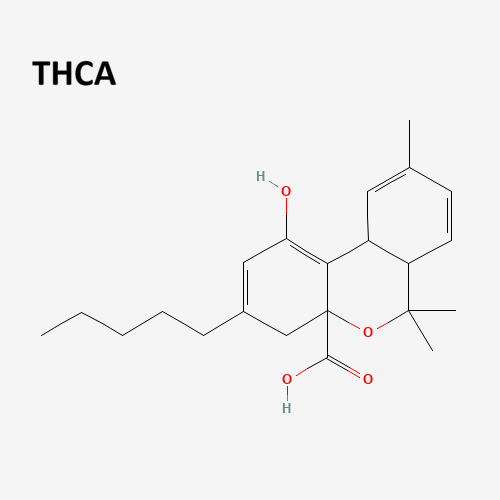
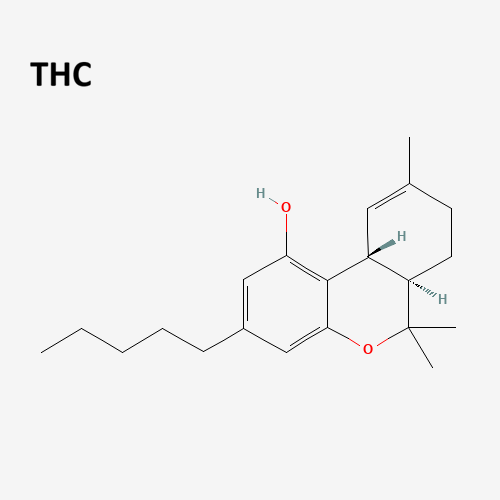
Now this type of story is quite common in Texas. These were most prevalent in vape products but as of recent, these have been banned under the new Texas ban on vapes and e-cigarettes on September 1, 2025. However, gummies, edibles, drinks and other CBD products remain legal and available to the public and are under strict regulation by banning any products that contain more than 0.3% of delta-9 THC by dry weight [1]. Delta-9 THC is a psychoactive compound and is the main component in marijuana that gives it its well-known effect. However, its precursor compound, THCA, was previously unregulated but has been regulated by the federal government recently and is currently facing immense scrutiny in Texas under the new Total THC rules [2][3]. The difference? A carboxyl group attached to the ring, but this minor difference removes its ability to affect the CB1 and CB2 receptors that engender the signature profile of marijuana [4]. To transform THCA to delta-9 THC is quite trivial. The act of heating THCA will decarboxylate it to become the illegal substance, delta-9 THC.
Whether or not there is agreement between personal opinion and the current law, the aim is to ensure faith in the scientific establishment and its ability to uphold rigorous standards. So what does this have to do with the testing method? GC-MS is a machine that requires extreme heating of the sample to analyze the chemical compound but like any method, it has its limits. Compounds susceptible to the temperatures experienced within the column of the machine often experience difficulty in analysis of which THCA is one. When THCA goes through the GC-MS apparatus, it is often converted into delta-9 THC which means that the results shown will overshoot the real concentration present in the sample. In fact, a recent paper by Mulloor, Wilson, and Sander showed that plant matrix THCA completely decarboxylates into delta-9 THC [5]. The paper mainly argues that the very inlet (the “tube” where the sample enters) reacts with both compounds and affects the calibration accuracy of the reading. They proposed using blocking agents that prevented the compounds to react with the walls of the inlet which improved accuracy of the readings.
This might not yet make sense as I’m throwing jargon that may be confusing. GC-MS is a method that combines two techniques for chemical characterization. It starts by separating the compounds on a column by chemical properties. This is the GC part or Gas Chromatography. Gas Chromatography works by essentially evaporating chemicals through a tube towards the other side. The tube will have a “stickiness” to it which may or may not make it easy for a compound to pass through; different compounds will separate at different speeds due to differences in chemical properties.
Example GC-MS Chromatogram
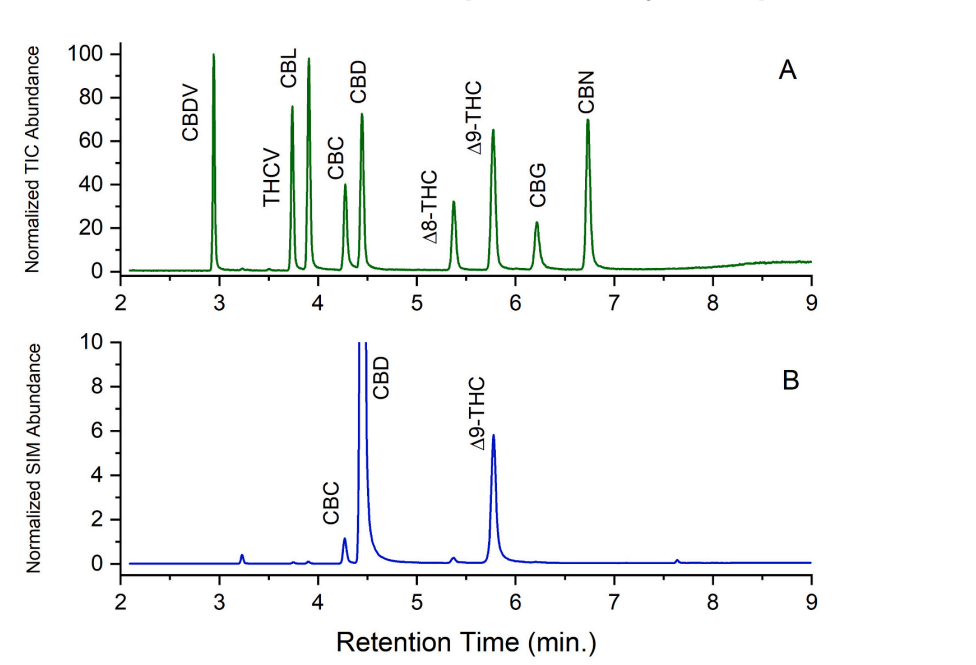 Courtesy of Mulloor, J., Wilson, W. and Sander, L. (2025)
Say that two of these peaks are THCA and delta-9 THC. One will go through the column faster due to that one carboxyl group difference. Once each gets to the other side, they will go through the MS part or Mass Spectrometry. This part will separate the compound to provide a unique “signature” that can identify the compound. The specifics aren’t important but the overall idea is simple. Separate, and identify. The Mass Spectrometer often needs a pure sample which GC provides. Once you know which compound is which, you can look at the chromatogram and calculate the area below the peak to obtain a “base signal” that tells the user, “whatever concentration you provided in this compound, this is the signal strength of it.” Essentially, the height and area of the peak is proportional to how much substance there is. The more THCA, the higher the peak.
On the first matter, suppose that the above peaks are the true concentrations of a sample, then the decarboxylation would completely remove one peak and make the other much larger. That other one would be delta-9 THC which means that it would be overestimating the true delta-9 concentration in the sample.
On the second matter, if a significant portion of the sample reacts or attaches to the tube inlet, then the peaks on the calibration will be smaller and thus, your calibration will overestimate future readings. To make it simpler, imagine that you are a soccer coach and you have a spreadsheet in front of you that gives you the amount of goals made in a penalty kick from a practice set of 100 (all with a robot goalie). Your determination of the skill of your players is the amount of goals they make out of that 100. You find that the average score was 73/100 which is not too bad for your district. However, the next day the players come to a much smaller goal net which made the task substantially harder. You had to take the day off and had a substitute proctor the exercise. You come back to a 36/100 average. Have your players become worse that much in the next day? Obviously not, the goal net being smaller moved the average towards a lower score because it decreased the chances that a goal could be made. Similarly, the THCA and delta-9 THC attaching to the inlet is like making the goal net much smaller. If the hypothetical area under the peak would be 1000 with no interference of a particular calibration concentration of say 0.1%, with interference, the area could change to 500 for the same amount. Once you put a plant sample for instance that “protects” the sample from interacting with the tube, it will overestimate the total THC by a factor of ~2 barring the decarboxylation. This would be comparable to saying that the best soccer player in the world is just as good as a high school player since they scored the same even though their goal nets are different sizes.
 Courtesy of Free-Images.com
The first part was the central tension for a long time. If THCA converts to delta-9 THC, then GC-MS without the necessary precautions might be unreliable and may produce potentially false data. However, under the new Total THC rule, that tension will no longer be relevant the day it is enforced. Nevertheless, under this new rule, the second point still stands and introduces a new tension. Total THC may not be reliably measured by a naive GC-MS method.
The federal government uses the following formula to compute the “Total THC”:
\[ \text{Total THC} = (\text{THCA} \times 0.877) + \text{THC}\]This formula computes the “total potential THC” mass that one could have if the THCA were to be decarboxylated hence the 0.877 factor due to the loss of \(\text{CO}_2\). But this formula does not account for an ill-constructed calibration curve (the “reference” to find out how much of something is in the sample). It can still overestimate the Total THC unless precautions are taken such as using blocking agents (as mentioned here), isotope standards, or other corrections that improve accuracy [5].
So if GC-MS is not reliable without the necessary precautions, what gives? GC-MS remains a staple in many law enforcement laboratories, partly because it is faster and cheaper than other alternatives. But as the published work shows, without the necessary corrections the method can overstate Total THC. A sample could be reported above the legal threshold when a more rigorous method would place it below. The consequence is that people may be prosecuted on measurements that don’t reflect what was actually in the product. When a method’s biases are documented in the literature, relying on the uncorrected version raises a real question about whether the resulting evidence meets the scientific standard courts should demand.
Disclaimer: I am not endorsed by any of the authors of any paper or website cited here. These are conclusions based on my own analysis.
Sources Used
[1] Texas. 2026. “Guides: Cannabis & the Law: Consumable Hemp Products.” Texas.gov. 2026. https://guides.sll.texas.gov/cannabis/hemp-products.
[2] “Continuing Resolution Introduces Major Changes to Federal Regulation of Hemp-Derived Products | Advisories | Arnold & Porter.” 2025. Arnold & Porter. 2025. https://www.arnoldporter.com/en/perspectives/advisories/2025/12/major-changes-to-federal-regulation-of-hemp-derived-products.
[3] Bernier, Nathan. 2026. “Court Order Allows Smokable Hemp to Stay on Shelves in Texas.” KUT Radio, Austin’s NPR Station. KUT. May 2026. https://www.kut.org/business/2026-05-01/austin-tx-hemp-cannabis-ruling-temporary-injunction-granted-thca.
[4] Verhoeckx, Kitty C.M., Henrie A.A.J. Korthout, A.P. van Meeteren-Kreikamp, Karl A. Ehlert, Mei Wang, Jan van der Greef, Richard J.T. Rodenburg, and Renger F. Witkamp. 2006. “Unheated Cannabis Sativa Extracts and Its Major Compound THC-Acid Have Potential Immuno-Modulating Properties Not Mediated by CB1 and CB2 Receptor Coupled Pathways.” International Immunopharmacology 6 (4): 656–65. https://doi.org/10.1016/j.intimp.2005.10.002.
[5] Mulloor, Jerome, Walter B Wilson, and Lane C Sander. 2025. “New Perspectives on THCA Decarboxylation and Accurate GC–MS Quantitation of Total THC in Cannabis Using Analyte Protectants.” Forensic Chemistry, May, 100668–68. https://doi.org/10.1016/j.forc.2025.100668.
Below are additional resources to reference regarding research methodologies and their relevant statistics.
https://www.nist.gov/publications/cannabis-quality-assurance-program-exercise-1-final-report
https://tsapps.nist.gov/publication/get_pdf.cfm?pub_id=934517
This blog is operated under Curvature Analytics LLC.