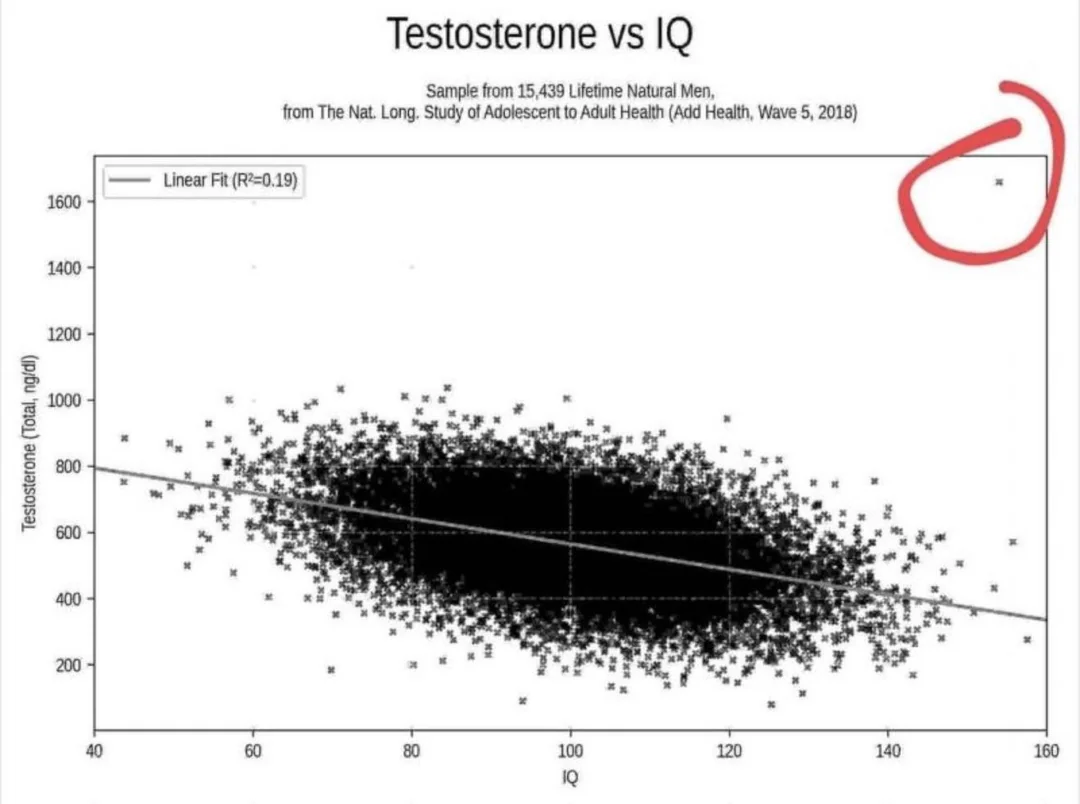
We have all seen the image. The scatterplot that affirms decades-old platitudes about brain vs brawn. But something peculiar stood out to most people, there is an individual who seems to have gone against all odds and proven themselves as a true outlier. Is it Dolph Lundgren? Christopher Langan? Gigachad? The speculations have run wild in the media.
However, there is something to pay attention to about the origin of the graph. Memes aside, it is important to also look at the truth. The graph appears to be from The National Longitudinal Study of Adolescent to Adult Health (Add Health, Wave 5). The study is real, “it is a longitudinal survey of a nationally representative sample of adolescents in grades 7-12 in the United States during 1994-95 school year”, according to the “Sampling and Mixed-Mode Survey Design” document which can be found in the Add Health website [1]. The study has then seen subsequent waves for different time windows. Wave 5 (Wave V) was sampled in 2016-2018 [2], with a total of 12,300 individual observations [3].
Therein lies the unusual nature of the graph, the title of the graph purports that there are 15,439 “Lifetime Natural Men” but the total sample of the Wave V cohort is 12,300 individuals which are supposed to be a mix of male and female. The graph also seems to obtain a measure of IQ from the sample, but the study only measures cognitive functions adjacent to IQ: Immediate word recall, delayed word recall, digits backward, picture vocabulary test [4]. While these could be used as a rough measure, the results would be unreliable. There is also the question on whether total testosterone is a biomarker assessed in the survey. Upon further investigation into the study design, there is no indication that total testosterone was measured in Wave V [1].
What could have been a deep analysis became a fact-checking exercise. This is a testament to the dangers of taking any charts or statistics that people may throw at you at face value. Perhaps there is not enough time for most people to look at things deeper but someone must do it.
So what does the literature actually say about testosterone and IQ? Not only are there different measures of testosterone levels - the graph uses total testosterone - but the picture is actually quite messy and inconclusive. Some saying that it is an inverse curvilinear relationship for women and a positive but plateauing relationship for men [5] while others point at highly intelligent children and children with intellectual disabilities as having equally low salivary testosterone [6]. A topic for another day.
[1] Mullan, Kathleen, Harris Carolyn, Tucker Halpern, Paul Biemer, Dan Liao, and Sarah Dean. n.d. “Sampling and Mixed-Mode Survey Design Report Prepared By.” https://doi.org/10.17615/v1vy-a536.
[2] Harris, Kathleen Mullan. 2025. “National Longitudinal Study of Adolescent to Adult Health (Add Health) Wave V, 2016-2018.” UNC Dataverse. https://doi.org/10.15139/S3/ZYRZ5J.
[3] “National Longitudinal Study of Adolescent to Adult Health | DUPRI.” 2016. Duke.edu. 2016. https://dupri.duke.edu/national-longitudinal-study-adolescent-adult-health.
[4] Yang, Yang Claire. “Modeling Trajectories of Cognitive Function across the Life Course: Integrative Data Analysis (IDA) of Add Health and Other Cohort Studies.” Presented at the 2022 Add Health Users Conference, Chapel Hill, NC, July 11–12, 2022. https://addhealth.cpc.unc.edu/wp-content/uploads/2022/07/Modeling-Trajectories-of-Cognitive-Function-across-the-Life-Course-Integrative-Data-Analysis-IDA-of-Add-Health-and-Other-Cohort-Studies_Yang.pdf.
[5] Tan, Üner, and Meliha Tan. 1998. “Curvelinear Correlations between Total Testosterone Levels and Fluid Intelligence in Men and Women.” International Journal of Neuroscience 95 (1-2): 77–83. https://doi.org/10.3109/00207459809000651.
[6] Ostatníková, Daniela, Peter Celec, Zdeněk Putz, Július Hodosy, Filip Schmidt, Jolana Laznibatová, and Matúš Kúdela. 2007. “Intelligence and Salivary Testosterone Levels in Prepubertal Children.” Neuropsychologia 45 (7): 1378–85. https://doi.org/10.1016/j.neuropsychologia.2006.10.018.